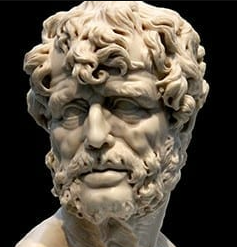
<aside> 💡 In a society filled with distraction and dissolution, it is hard to find a life filled with purpose and virtue. Introduce Stoicism, or more specifically, Seneca.
</aside>
Statue of Seneca
In particular, I will focus on Letters from a Stoic, a collection of 124 letters from Seneca to his friend Lucilius detailing aspects of living a virtuous and Stoic life. Written in a confrontational yet loving style, the letters portray a man who wants to do nothing but help but asks for nothing in return.
Firstly, I want to share something with you all. I have made a public Notion page that contains a letter-by-letter summary of all 124 letters, blending quotes and personal thoughts. Currently, I could not find a source on the internet that described every letter in a short summary. I hope you find it enjoyable as a constant source of quick wisdom in your daily life!
Letters From a Stoic - Seneca: Summary of all 124 Letters
Below, I will detail some things I’ve learned from reading the letters. I hope you find it helpful on your journey of improvement!
[Photo by Olga Vilkha 🇺🇦 on Unsplash](https://cdn-images-1.medium.com/max/800/0*yYiqCaCCFVniQYJH)
Photo by Olga Vilkha 🇺🇦 on Unsplash
To preface I would like to state the circumstance of the letters in the first place. Although written for a common audience, there is some beauty to me that Seneca devoted so much of his time and energy to crafting all these letters to Lucilius. Most of us (including myself) use little (if any) energy to persuade our friends opinions.
Conventional wisdom (from Stoicism also) tells us that we should not try to change anyone because their character is ‘out of our control’. However, Seneca was excited to hear counter-arguments back from his ‘resistant’ pupil and respond to them. Furthermore, he often times predicted his friend’s rebuttal mid-letter to further ponder on his own knowledge and experiences.
[Photo by Harli Marten on Unsplash](https://cdn-images-1.medium.com/max/800/0*ija7dJyFvniBKnGj)
Photo by Harli Marten on Unsplash
This brings me to the conclusion that Seneca wrote the letters for his own improvement. The way he helps his friend is by improving himself. This way, he is working with the things in his control. Here are some other ideas on friendship:
But if you consider any man a friend whom you do not trust as you trust yourself, you are mightily mistaken and you do not sufficiently understand what true friendship means.
When friendship is settled, you must trust; before friendship is formed, you must pass judgment.
-Letter III, On True and False Friendship
<aside> 👬 A friendship seems to be a surrender to the nature of other well-intentioned beings. Otherwise, by Seneca’s standards, it is fake.
</aside>
<aside> 😇 Epictetus wrote that what differentiates a good and bad person is that the former places priority on will, while the latter externals. We should work to find friends who have a desire to work towards being a good person.
</aside>
Seneca also hinted at the fleeting nature of friendship in LXIII. On Grief For Lost Friends:
[Photo by Ann on Unsplash](https://cdn-images-1.medium.com/max/800/0*a5bFNi_mMwlHAzzN)
We, however, may be forgiven for bursting into tears, if only our tears have not flowed to excess, and if we have checked them by our own efforts. Let not the eyes be dry when we have lost a friend, nor let them overflow. We may weep, but we must not wail. -Letter LXIII. On Grief For Lost Friends
Although he was referring to death, friends in our life will come and go like the waves of the ocean. As we moved around, we could see many people for the last time on any day. Some notable days are graduation or relocating to a new town. There are ones who fade away even on a random day. But we cannot overly grieve for them; even this should be in moderation. Let us enjoy the unguaranteed time with our friends.
The title of letter 47, On Master and Slave represents a correlation between literal master and slaves, but also between virtues and vices, the power of the mind, and much more. Firstly, take some ideas from letter 47: